Analysis · Mar 2026
Etho Hour
The Short Answer
What Is a Minecraft Tick, and What Is an Etho Hour?
A Minecraft tick is one step of the game loop. Minecraft targets 20 ticks per second, so one tick is 0.05 seconds — but that is a target, not a promise. Under load the tick rate drops, and every timer in the game slows with it. That is why a farm rate quoted "per hour" is not reproducible.
An Etho hopper clock fixes this by counting ticks instead of seconds. Two hoppers pass items back and forth, and each transfer starts an 8-tick cooldown, so a clock holding x items runs 8x − 6 ticks per cycle.
An Etho Hour is 150 items in that clock — 1,194 ticks per cycle — counted 60 times: 71,640 game ticks. That is ~59.7 real minutes at 20 TPS and ~79.6 at 15 TPS, but it is always exactly 71,640 ticks, which makes any rate measured against it reproducible on any machine.
The Problem
There Is No Standard Unit of Time in Minecraft
If you asked ten Minecraft players how long a minute is, you'd get ten different answers — and none of them would be wrong. The game has no official, reliable unit of time that players can use as a shared reference point. "A minute" in Minecraft means something different on a loaded single-player world, a busy multiplayer server, and a lagging server farm.
This matters more than most players realize. Farm output rates, redstone timing, mob spawning cycles, item despawn windows, potion durations — all of these are measured in time. If your unit of time is unreliable, every measurement you make is unreliable with it.
The root cause is the tick. Minecraft's internal clock runs in ticks, not seconds. And ticks are not guaranteed to line up with real-world time.

Mechanics
The Tick — Minecraft's Unit of Time
Minecraft targets 20 ticks per second (TPS). Under ideal conditions, each tick takes exactly 50 milliseconds to process, and 20 of them add up to one second of real-world time. This is the definition most tutorials assume, and it works fine on a fresh single-player world with nothing loaded.
The moment the game experiences any latency — from chunk loading, from entities, from redstone, from server load — ticks start to fall behind. The server can't make up lost time. A tick that takes 80ms to process is still just one tick, but it consumed 80ms instead of 50ms. The next second of real time might contain only 12 ticks instead of 20.
At 18 TPS, what feels like a minute is actually 66.7 real seconds. At 15 TPS, that "minute" stretches to 80 seconds. At 10 TPS — which is not unusual on a busy public server — your minute is now two real-world minutes long.
Any farm or contraption that was designed and measured at 20 TPS will drift under real conditions. More importantly, any comparison between farms measured under different TPS conditions is meaningless. You're not comparing the farms — you're comparing the server loads they were tested under.
The solution is to stop measuring in real seconds entirely. Measure in ticks. And to do that reliably across all conditions, you need a clock that counts ticks — not wall-clock time.
The Clock
The Etho Hopper Clock
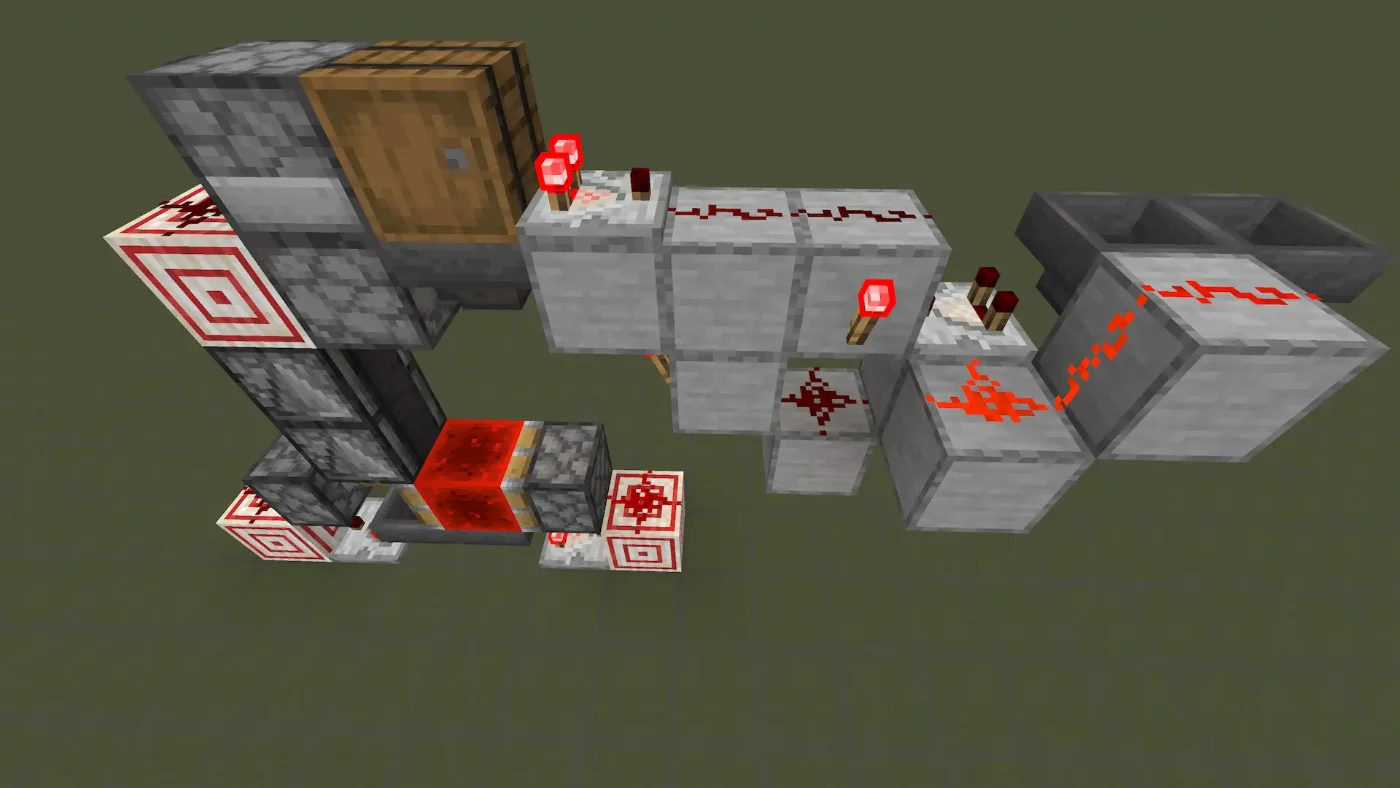
The Etho Hopper Clock — named after the Minecraft YouTuber Etho, who popularized the design — is one of the most precise timing mechanisms available in vanilla Minecraft. It consists of two hoppers facing each other with items bouncing continuously between them. Each time an item successfully transfers through a hopper, the hopper enters an 8-tick cooldown before it can transfer again.
The result is a clock whose cycle length is directly determined by the number of items inside it. With x items in the clock, each full cycle takes:
Ticks per cycle
8x − 6
where x = number of items in the hopper clock
The −6 accounts for a small timing offset that occurs at the transition points of the cycle. This formula holds precisely and consistently, tick for tick, regardless of server load — because hopper cooldowns are measured in ticks, not in real-world milliseconds. The clock slows down when the server slows down, and speeds back up when the server recovers. It is, by definition, lag-resistant.
This is exactly the property we need. A clock that runs in lock-step with the game itself, giving us a unit of time that is consistent relative to the game's execution — even when that execution is inconsistent relative to the real world.
Construction
Building an Etho Hour
The goal is a clock that approximates one minute at 20 TPS and then counts 60 of those minutes to produce one "Etho Hour." We start by choosing the item count for the base clock.
One real minute at 20 TPS = 1,200 ticks. Solving the formula for x:
Finding x for ~1 minute
8x − 6 = 1,200
8x = 1,206
x = 150.75
Rounding to 150 items gives 8(150) − 6 = 1,194 ticks per cycle — six ticks short of a "real" minute at 20 TPS.
Those six missing ticks are intentional. 1,194 is a clean, consistent number that we can work with precisely. The definition of an Etho minute is simply 1,194 game ticks — not "approximately 60 seconds."
To build an Etho Hour, attach a 60-item counter to the base clock. The counter increments by one each time the 150-item clock completes a full cycle. When the counter reaches 60, one Etho Hour has elapsed:
Etho Hour in ticks
60 cycles × 1,194 ticks
= 71,640 ticks
At 20 TPS this is ~59.7 real minutes. At 15 TPS this is ~79.6 real minutes. In both cases, it is exactly 71,640 game ticks.
The counter itself can be implemented in several ways: a hopper line that fills incrementally, a binary counter for precision, or any redstone circuit that can count 60 pulses from the clock output. The complexity of the counter doesn't affect the accuracy of the measurement — only the base clock determines that.
Applications
Why This Matters
The Etho Hour is not an academic curiosity. It has direct, practical implications for anyone doing serious technical work in Minecraft.
Farm comparisons. Every bamboo farm in my comparison study was measured in Etho minutes. This is the only way to ensure the numbers mean something — two farms tested at different TPS values on separate sessions would otherwise be incomparable. Measuring in ticks removes that variable entirely.
Redstone timing. Any circuit that needs to fire on a precise interval — an AFK alert, a harvest cycle, a scheduled output flush — benefits from being built around a tick-based clock rather than a real-time one. Your contraption will behave the same way at 20 TPS as it does at 15 TPS, because both conditions see the same number of ticks.
Spawning and despawn windows. Mob spawning rates and item despawn timers (items disappear after 6,000 ticks, always) are tick-based. If you're trying to understand or optimize spawning behavior, you need a tick-based reference. Real seconds will mislead you.
Data collection. Any time you're gathering output data from a farm or contraption, the Etho Hour gives you a denominator that is replicable. "Bamboo per Etho Hour" is a meaningful number you can share with other players and reproduce on different servers. "Bamboo per real hour" is a number that depends on conditions that are impossible to standardize.
The Etho Hour doesn't replace real-world time — it gives technical players a consistent alternative when real-world time is too unreliable to use. It is, in a small way, a solution to the fact that Minecraft was never designed with rigorous measurement in mind.
Support the Creator
Enjoying the builds?
Every world on this site is completely free. If you'd like to support future projects, each tier below comes with a permanent thank-you built into the work itself.
Community
Download and explore every world on this site at no cost, forever. No strings attached.
Always FreeSupporter
Your name credited at the end of all related YouTube videos.
Choose This Tier →Patron
A named sign placed inside future world downloads as a permanent thank-you.
Choose This Tier →Champion
A small statue or named mob in your honor built into future world downloads.
Choose This Tier →Monthly tiers via Patreon.